Essential Supplies for Herb Growing Indoors
Starting an indoor herb garden doesn't require a cart full of gardening equipment. In fact, one of the easiest beginner mistakes is buying too much before you know what your plants actually need.
A few healthy herbs, suitable containers, good potting mix, light, and water will take you surprisingly far.
The trick is knowing which items are genuinely useful and which can wait.
This guide covers the essential supplies for herb growing indoors, explains what each one is for, and points out the equipment you probably don't need when you're just getting started.
Herbs, Seeds, or Cuttings
Every herb garden needs plants, but you have several ways to get them.
You can start with:
- established herb plants
- young starter plants
- seeds
- cuttings from existing herbs
- supermarket herb pots
For a complete beginner, established plants are often the simplest choice. You can concentrate on learning about light, watering, and harvesting without also having to manage germination.
Seeds cost less and offer far more varieties, but they require additional time and attention.
Cuttings can be an inexpensive way to produce new plants from herbs you or someone else already grows.
There's no need to choose one method for your entire garden. You might buy a basil plant, start parsley from seed, and root a mint cutting in water.
Pots With Drainage Holes
If you're going to spend money somewhere, choose containers that work for the plant rather than pots that merely look attractive.
The most important feature is simple:
Water needs somewhere to escape.
Containers without drainage holes can allow excess water to collect around the roots. That's particularly troublesome for beginners because it's much harder to judge how wet the lower part of the pot remains.
Plastic nursery pots are perfectly usable. Terracotta pots are popular because they're inexpensive, attractive, and porous, although they can dry out more quickly.
Decorative ceramic containers work too.
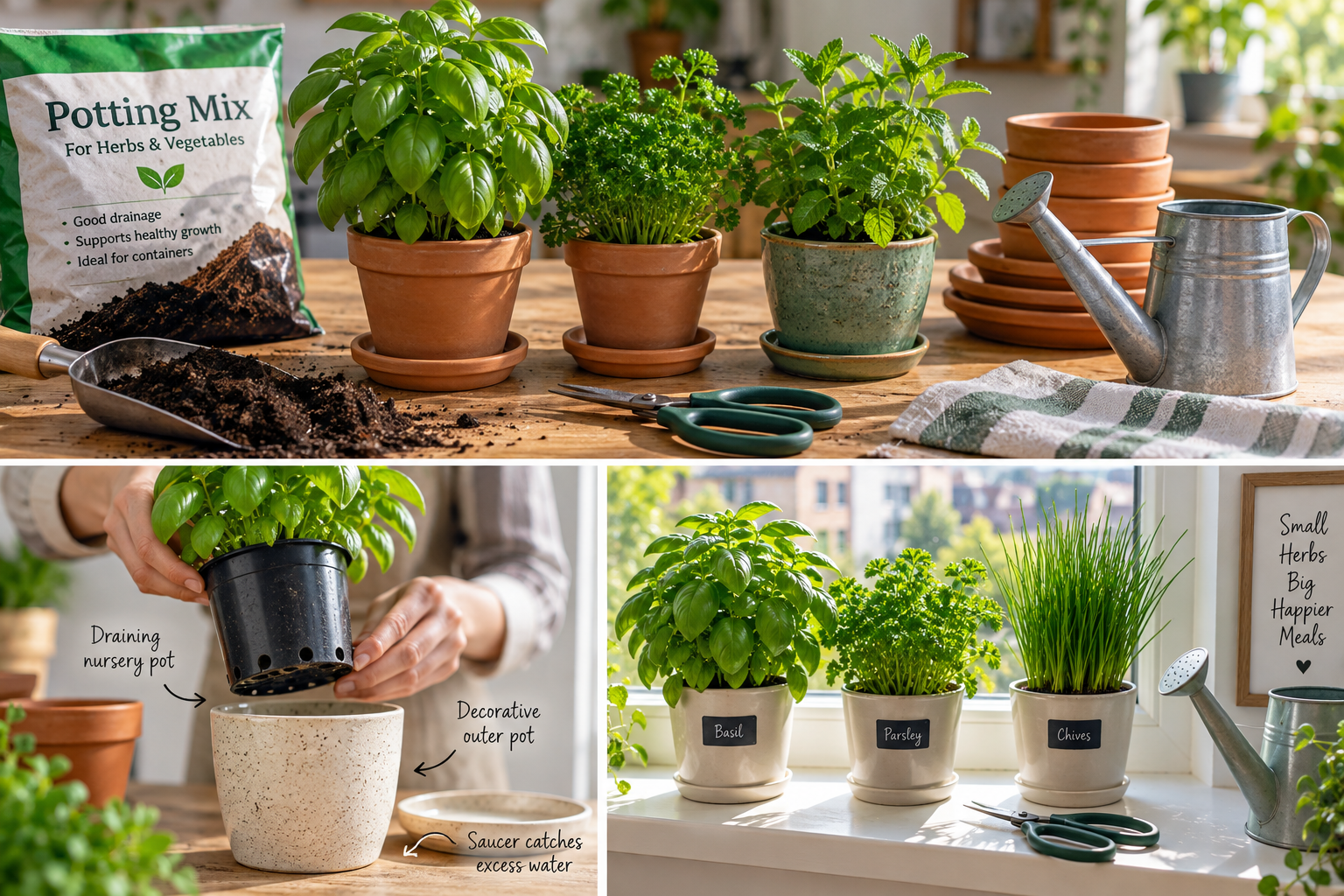
If your favorite decorative pot doesn't have a drainage hole, you don't necessarily have to drill one. Keep the herb in a smaller draining pot and place that inside the decorative outer container.
That gives you appearance and drainage.
Saucers or Drip Trays
Drainage holes create another problem:
The water has to go somewhere.
A saucer underneath each container protects windowsills, shelves, countertops, and furniture.
Choose a saucer large enough to catch water draining from the bottom of the pot.
Don't treat the saucer as a permanent reservoir unless you're growing a plant that specifically benefits from that arrangement. If a large amount of water remains after watering, empty it rather than leaving the pot sitting in water indefinitely.
It's a small, inexpensive item that can prevent both plant problems and unhappy furniture.
Good Potting Mix
Soil from the backyard isn't the best default choice for a container on your kitchen windowsill.
For indoor herbs, use a potting mix intended for container growing.
A suitable mix should hold enough moisture for roots to access water while still allowing excess water and air to move through the root zone.
Garden soil can become dense in containers and may drain poorly. Bringing outdoor soil indoors can also introduce organisms, weed seeds, or pests you didn't intend to invite into your apartment.
You don't need to become a soil scientist before growing your first basil plant.
A good-quality general-purpose potting mix suitable for indoor container plants is a sensible starting point for many common culinary herbs.
As you gain experience, you may choose different mixes for plants with particular drainage or moisture preferences.
A Suitable Light Source
Technically, light isn't something you need to buy.
If you have enough natural light, the sun is the cheapest piece of gardening equipment you'll ever own.
Before purchasing a grow light, identify the brightest practical locations in your home and observe how much direct and bright indirect light they receive.
For many beginners, a good windowsill is enough to start experimenting.
If your apartment doesn't provide sufficient natural light, a grow light becomes one of the few pieces of additional equipment that can fundamentally change what you're able to grow.
You don't necessarily need a large professional fixture. A compact LED grow light designed for plants can support a small indoor herb setup.
Something to Water With
You need water.
You don't necessarily need a watering can.
A small watering can with a narrow spout is convenient because it lets you direct water toward the soil without soaking leaves or spilling water across the windowsill.
But a jug, cup, or other clean container can perform the same basic job.
For a few small pots, use whatever gives you good control.
The more important skill is learning when to water, rather than buying a sophisticated tool for doing it.
Check the soil and observe the plant instead of watering automatically according to a fixed calendar.
Scissors or Herb Snips
Indoor herbs are meant to be used.
A small pair of clean scissors or herb snips makes harvesting easier and allows you to make cleaner cuts than tearing at stems with your fingers.
You don't need expensive professional pruning shears for a windowsill basil plant.
A small, sharp pair of scissors dedicated to your plants is sufficient for many common culinary herbs.
Keep them clean, particularly when moving between plants.
Regular harvesting can also become part of maintaining healthy, productive growth, depending on the herb.
Plant Labels — Optional but Useful
If you're starting with three obviously different established herbs, you probably know which one is mint.
Once you begin sowing multiple varieties, things become less obvious.
Plant labels are inexpensive and useful for recording:
- herb name
- variety
- sowing date
- planting date
You can buy labels, reuse suitable household materials, or make your own.
They're especially helpful when several pots contain seedlings that look almost identical during their first weeks.
A Small Scoop or Spoon
A gardening scoop makes filling and repotting containers cleaner and easier.
But for a tiny indoor garden, it isn't essential.
An old spoon or small scoop that you no longer use for food can do the job perfectly well.
This is a good example of a recurring principle in beginner gardening:
Buy a tool because you need it, not because it appears on a gardening checklist.
What About Fertilizer?
Eventually, container-grown herbs may need additional nutrients.
That doesn't mean fertilizer has to be one of the first things you use when bringing home a new plant.
Commercial potting mixes may already contain nutrients, and recently purchased or repotted plants don't necessarily need immediate feeding.
When fertilizer does become appropriate, use a product suitable for edible plants and follow its directions rather than assuming more fertilizer means faster growth.
Overfertilizing can create problems of its own.
Treat fertilizer as part of ongoing plant care, not as a magic ingredient that every beginner must apply on day one.
Do You Need a Moisture Meter?
Moisture meters sound ideal for beginners.
Push a probe into the soil and let a gadget tell you when to water.
They can be useful, but they aren't essential.
Learning to feel the upper part of the potting mix and observe the weight and condition of the plant teaches you something a meter can't: how plants behave in your home.
For a handful of herbs, your finger is a perfectly respectable moisture-testing device.
If you later find a meter genuinely useful, buy one then.
Do You Need a Grow Light?
Maybe.
Unlike many optional gadgets, a grow light can solve a real limitation: insufficient light.
But establish that you have the problem first.
If your herbs receive adequate natural light and grow well, adding a lamp simply because indoor gardeners are “supposed” to own one adds cost and clutter.
If your apartment is dark, or winter dramatically reduces available daylight, artificial lighting can be a very worthwhile upgrade.
Your plants should determine the purchase.
Equipment You Probably Don't Need Yet
It's easy to turn a three-pot herb garden into a technology project.
A beginner usually doesn't need to start with:
- automatic watering systems
- propagation stations
- expensive moisture sensors
- humidity controllers
- large grow tents
- professional pruning tools
- multiple fertilizers and supplements
- elaborate hydroponic systems
None of those things are inherently useless.
They simply solve problems you may not have.
Start growing first. Upgrade later.
A Minimal Shopping List
If you want the shortest possible answer, here's what I'd buy for a first indoor herb garden:
Plants
Two or three healthy herbs you actually use.
Pots
One appropriately sized draining container for each herb.
Saucers
One underneath each draining pot.
Potting mix
A good container-growing mix suitable for your herbs.
Scissors
A small clean pair for harvesting.
That's enough if you already have a suitable bright location and something you can use to water the plants.
If natural light isn't sufficient, add:
A small grow light.
Everything else can wait.
How Much Should a Beginner Spend?
Not much.
An indoor herb garden doesn't become more successful because its equipment is expensive.
Spend first on healthy plants, appropriate containers, and suitable potting mix.
Reuse what you already own where it makes sense. A perfectly functional nursery pot doesn't need to be replaced merely because a matching ceramic pot would look better on Instagram.
Once you've kept your first herbs healthy for a while, you'll have a much better idea where spending a little extra money could actually improve your setup.
Buy Less, Learn More
The most useful thing a beginner can bring to an indoor herb garden isn't a gadget.
It's attention.
Notice where sunlight falls. Check the soil. Watch how quickly different pots dry. Look at new growth. Harvest your herbs. Notice when something changes.
Start with the essentials and let your plants tell you what else you need.
If you're still planning your first setup, return to our beginner guide:
Back to: Getting Started With Indoor Herb Gardening →
And if you've already gathered your supplies, the next question is which herbs deserve a place on your windowsill:
Explore: Best Herbs for Apartments →