Getting Started With Indoor Herb Gardening
Growing fresh herbs indoors is one of the easiest ways to bring a little gardening into your home. You don't need a backyard, a greenhouse, or even a balcony. A bright windowsill, a few suitable pots, and the right herbs can be enough to get started. If you're starting from scratch in a smaller home, our apartment herb garden for beginners walks through a simple first setup.
The challenge for beginners is usually not finding information. It's figuring out which advice actually matters.
Do you need special grow lights? Should you start herbs from seed or buy plants? How often should you water them? Can you keep supermarket herbs alive? And how much equipment do you really need before you can call that sunny corner of your kitchen an herb garden?
The good news is that an indoor herb garden can be remarkably simple.
This guide will walk you through the basic decisions you need to make when getting started with indoor herb gardening, without turning your first few pots of basil and mint into a complicated horticultural project.
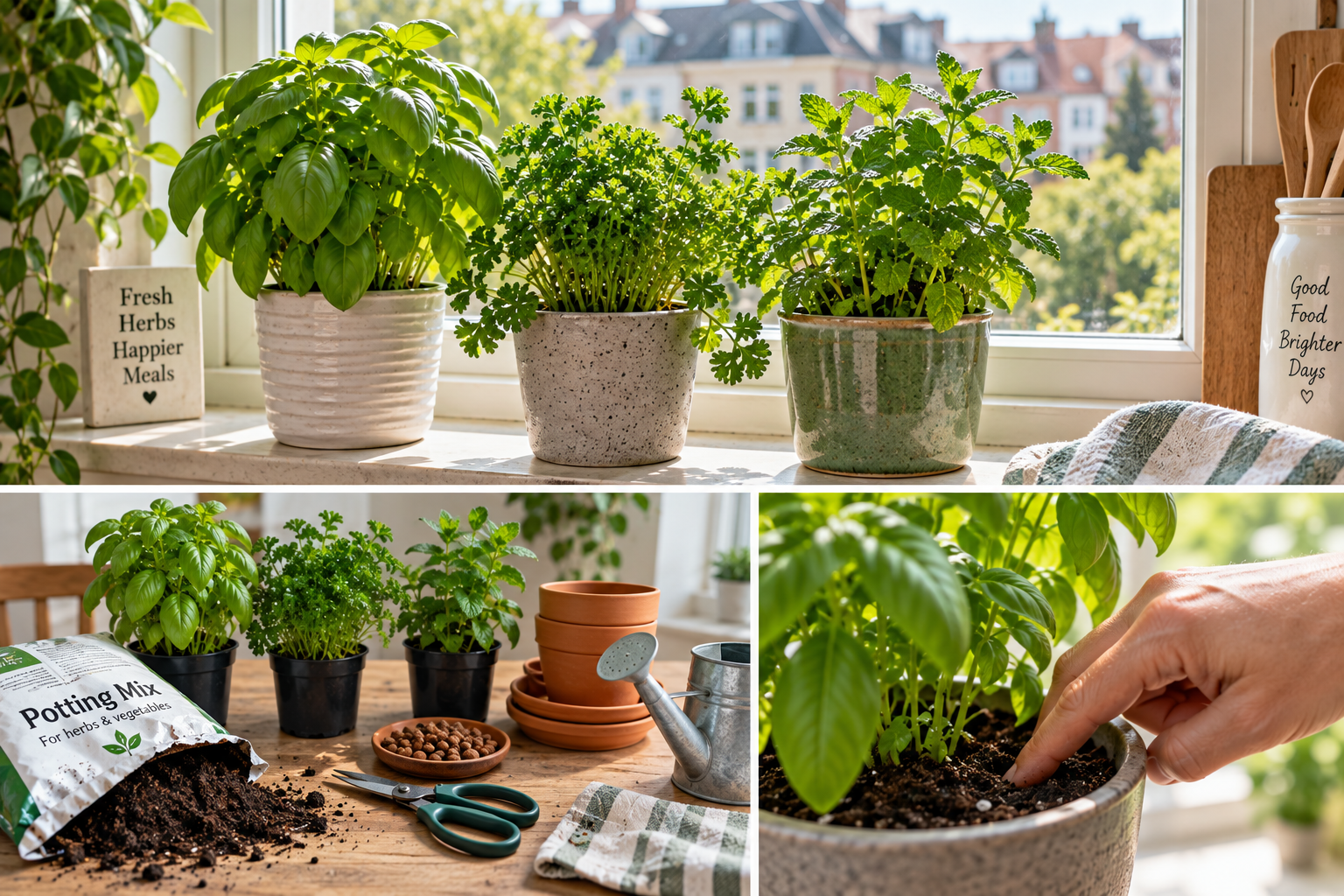
Before choosing herbs, take a look around your home.
The most important question isn't how much space you have. It's how much usable light you have.
Many common culinary herbs prefer several hours of bright light each day. A sunny windowsill can therefore be more useful than a large table in a dark corner of the room.
Watch your potential growing spot over the course of a day. Does it receive direct sunlight? For how many hours? Does a neighboring building block the sun later in the day?
Don't worry if your home isn't flooded with sunlight. Some herbs tolerate lower-light conditions better than others, and a small grow light can make otherwise unsuitable locations much more useful.
Space doesn't need to be a deal-breaker either. A few pots on a windowsill, shelf, kitchen counter, or small plant stand may be all you need.
And no, you don't need a balcony.
Once you've found a suitable location, you need some plants.
There are several ways to get them.
Starting from seed
Seeds are inexpensive and give you a much wider choice of varieties. Watching your first seedlings appear is also one of the more satisfying parts of gardening.
The downside with starting from seed is patience. Seeds need the right combination of moisture, warmth, and light, and it can take weeks before you have plants large enough to harvest.
Buying starter plants
Small established plants give you a head start. You skip germination and can concentrate on keeping an already-growing herb healthy.
For a complete beginner, this is often the easiest route.
Using supermarket herbs
That lush pot of basil from the grocery store looks like an instant indoor herb garden.
Sometimes it can be—but supermarket herb pots aren't necessarily grown with long-term survival in mind. They often contain many young plants packed tightly together, all competing for water, nutrients, and root space.
With some attention, however, you can often give them a much better chance of surviving.
Growing new plants from cuttings
Some herbs can even be multiplied from plants you already have.
A cutting placed in water may develop roots and eventually become a new plant. It's inexpensive, fun to watch, and particularly useful with herbs that root readily.
You don't have to choose only one method. Starting with one or two established plants while experimenting with seeds or cuttings is a great way to learn.
Indoor herb gardening has no shortage of accessories, but your first setup can be surprisingly basic.
See our essential supplies for herb growing guide for a closer look at what you really need.
At minimum, think about:
- healthy plants or seeds
- containers with drainage holes
- suitable potting mix
- a bright location
- something to catch excess water
- access to water
- a small pair of scissors or snips for harvesting
The container deserves particular attention.
A beautiful pot without drainage may look great on a kitchen counter, but trapped water around the roots can cause problems. If you want to use a decorative container without drainage holes, consider placing the herb in a smaller draining pot inside it.
You also don't need enormous pots for your first herbs. The appropriate container size depends on the plant and its stage of growth.
What about fertilizer, moisture meters, propagation stations, humidity equipment, and grow lights?
They can all have their uses. That doesn't mean you need to buy them before planting your first herb.
Start with the essentials and add equipment when you encounter a problem it actually solves.
If cost is a concern, an indoor herb garden can also be assembled very economically.
A row of ten different herbs across the kitchen window may look like the perfect beginning.
It can also give you ten different plants to understand at once.
Start small.
Two or three herbs are enough to teach you how quickly the soil dries, how plants respond to your available light, and how often you actually use what you grow.
Choose herbs you genuinely cook with.
There's little benefit in successfully growing a large pot of an herb you never eat. If basil goes into your pasta every week, start with basil. If you regularly make tea with mint, mint earns its place.
Once those first plants are doing well, expanding your collection becomes much easier.
If you're unsure which plants are best suited to your home, the next section of this site will help you choose.
One of the easiest beginner mistakes is doing too much.
You bring a plant home, immediately repot it, move it twice, give it fertilizer, water it generously and start harvesting leaves.
Meanwhile, the plant is already adjusting to a new environment.
When you introduce a new herb to your home, give it a suitable location and observe it. Check the soil rather than watering automatically just because another day has passed.
Different herbs and different homes produce very different watering schedules.
A small pot sitting in several hours of direct summer sun may dry quickly. The same plant in a cooler, less sunny location may remain moist much longer.
This is why “water every X days” is rarely a perfect rule.
Learn to look at the plant and feel the soil.
During that first week, pay attention to:
- how quickly the soil dries
- whether leaves remain firm or begin to droop
- how much direct sunlight reaches the plant
- whether water can drain freely
- signs of insects or damaged leaves
You will learn more from a week of observation than from trying to follow a rigid care schedule.
If there's one habit worth learning early, it's this one.
Don't water simply because it's Tuesday.
Check whether the plant actually needs water.
Push a finger gently into the upper layer of soil. If it still feels noticeably moist, the plant may not need more water yet. If it feels dry, watering may be appropriate depending on the herb.
When you do water, make sure excess water has somewhere to go.
Both chronic overwatering and repeatedly allowing an unsuitable herb to dry out can cause trouble. Learning the preferences of each plant will eventually become part of your routine.
This is another reason to begin with only a few herbs.
You aren't keeping indoor herbs just to admire them.
Use them.
Regular harvesting can encourage many culinary herbs to produce new growth, provided you don't remove too much at once.
Use clean scissors or snips and take what you need while leaving enough healthy foliage for the plant to continue growing.
As your plants mature, you'll learn that harvesting isn't merely the reward at the end of the process. It becomes part of caring for the plant.
And few things make indoor gardening feel more worthwhile than cutting fresh herbs a few steps away from where you're cooking.
If you share your home with a cat, dog, or another curious pet, plant choice and placement deserve some extra thought.
Don't assume that something is safe for a pet simply because humans use it as a culinary herb.
Before bringing plants into an area your pet can reach, check whether that particular plant is considered safe for the animals in your home.
Placement matters too. Even a plant that isn't particularly tempting can become interesting to a cat when it's sitting on a sunny windowsill.
You don't need to design your ultimate indoor garden before you begin.
For a first attempt, keep the plan simple:
- Find your best growing spot.
Look for a location with plenty of usable natural light. - Choose two or three herbs you actually use.
Don't build a collection just for the sake of variety. - Start with healthy plants if you want the easiest route.
Seeds and cuttings can come later—or become a small experiment alongside your established plants. - Use containers that allow excess water to escape.
Good drainage removes one of the most common sources of beginner problems. - Observe before you intervene.
Check the soil, leaves, growth, and light rather than watering or feeding according to an arbitrary schedule. - Harvest and enjoy what you grow.
Your indoor herb garden doesn't have to be perfect to be useful.
That's enough to begin.
Once you've successfully kept a few herbs growing, you can experiment with different varieties, propagation, larger containers, grow lights, and more ambitious setups.
But first, you need to decide which herbs deserve those first few pots.
Some herbs adapt to apartment life much more readily than others. Your available light, space, cooking habits, and even your pets can influence which ones make the best choices.
Next: Best herbs for apartments →