Budget Indoor Herb Garden List: What You Really Need
Starting an indoor herb garden can become surprisingly expensive if you let the gardening aisle decide what you need.
Matching ceramic pots. Moisture meters. Propagation stations. Special scissors. Plant food. Grow lights. Seed-starting kits. Decorative labels.
Before long, three little herbs have acquired more equipment than your kitchen.
Fortunately, they don't need most of it.
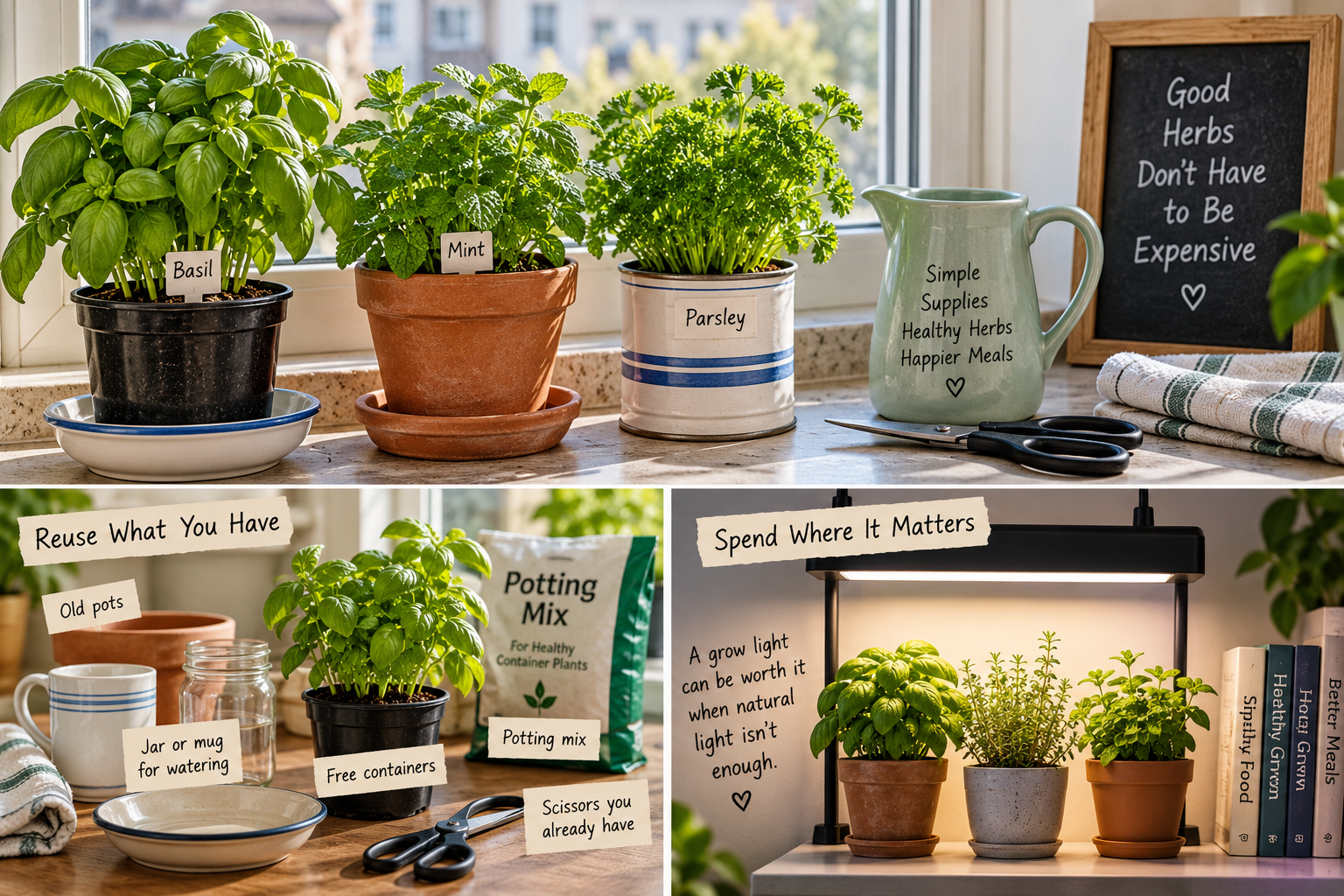
A basic indoor herb garden can be inexpensive, particularly if you're willing to reuse containers and household items you already own. Spend money where it affects the plants and save it where it doesn't.
This budget indoor herb garden list separates the things worth buying from the things you can reuse, improvise, or simply leave on the shelf.
The Shortest Possible Budget Herb Garden List
If you want to start with just a few established herbs, your list can be remarkably short:
- two or three herb plants
- containers with drainage holes
- saucers or drip trays
- suitable potting mix
- a bright location
- something to water with
- scissors for harvesting
That's it.
You may already own several of those things.
If your home doesn't provide enough natural light, a grow light becomes the main potential additional expense. But don't buy one before determining whether you actually need it.
1. Spend Money on Healthy Herbs
The plants themselves are an obvious expense, but you don't need a large collection.
Start with two or three herbs you genuinely use.
Buying six or eight different plants because they're inexpensive can be false economy if half of them end up neglected or unsuitable for your growing conditions.
Look for healthy plants rather than the biggest plants. Avoid specimens with obvious pest problems, extensive damaged foliage, or severely stressed growth.
You can also reduce future plant costs by growing from seeds or propagating suitable herbs from cuttings.
But for your very first garden, a couple of healthy established plants can make starting much easier.
2. Cheap Pots Are Perfectly Fine
Your basil doesn't know what its pot cost.
An inexpensive plastic nursery pot with proper drainage can be more useful than an expensive decorative container with no drainage hole.
If plants already came in suitable nursery pots, you may not need to repot them immediately.
When you do need containers, prioritize:
- adequate size
- drainage holes
- stability
- easy access for watering
Appearance is optional.
Terracotta pots are another relatively simple choice, but there's no requirement for every herb on your windowsill to have a matching home.
3. Reuse Containers — But Keep Drainage in Mind
Household containers can sometimes become plant pots.
The critical question is whether excess water can escape.
If you're comfortable making drainage holes in a suitable reused container, it may work perfectly well for herbs.
Another option is to use an attractive container as a decorative outer pot while keeping the herb in a smaller draining nursery pot inside it.
Don't improvise away the drainage requirement just to save the price of a basic plant pot.
4. Don't Forget Cheap Saucers
A pot with drainage holes needs somewhere to drain.
You can buy inexpensive plant saucers, but you may already own something suitable for catching small amounts of excess water.
Whatever you use should be waterproof, stable, and wide enough for the pot.
The goal isn't horticultural sophistication.
It's preventing watering day from damaging your windowsill.
Don't leave the container standing indefinitely in a large amount of drained water.
5. Buy Potting Mix, Not Garden Soil
Potting mix is one of the items where saving a few euros or dollars by using whatever soil you can find isn't necessarily worthwhile.
Container herbs benefit from a well-draining growing medium.
Fortunately, you don't need an enormous bag for a windowsill containing a few small pots.
Buy an appropriate amount for the number of plants you're actually growing.
And don't automatically buy several bags of specialist mixes for your first three herbs. Start with a suitable general container mix unless a particular herb requires something different.
6. Your Watering Can May Already Be in the Kitchen
A dedicated indoor watering can is pleasant to use.
It isn't mandatory.
For two or three small pots, a jug, bottle, or other clean household container can deliver water perfectly well.
Use something that lets you control where the water goes.
If you later build a larger collection, a narrow-spouted watering can may become a worthwhile convenience.
Until then, this is an easy place to spend nothing.
7. Ordinary Scissors Can Be Herb Scissors
You need a clean way to harvest and occasionally trim your herbs.
You don't need professional pruning equipment.
A clean, sharp pair of household scissors can be enough for many soft culinary herbs.
If you already own suitable scissors, your budget for this item is:
zero.
Keep them clean and avoid using something so blunt that you're crushing stems rather than cutting them.
8. Use Free Natural Light First
Light is one of the most important resources in an indoor herb garden—and potentially the most expensive problem to fix.
Before buying anything, examine your windows.
Use the brightest practical location available and see whether it suits the herbs you want to grow.
If your herbs grow well with natural light, you've solved the lighting problem for free.
If they don't, then consider spending money on artificial lighting.
9. When a Grow Light Is Worth the Money
A grow light isn't an unnecessary gadget if insufficient natural light is the thing preventing your plants from growing properly.
In that situation, it's solving a real problem.
For a small collection, you don't necessarily need an elaborate indoor growing installation.
Before buying one, ask:
Do my herbs actually need more light?
If the answer is yes, a grow light may deserve a much higher place in your budget than decorative pots, plant labels, meters, or specialized tools.
10. Skip the Moisture Meter for Now
A moisture meter is inexpensive enough that it can feel like an essential beginner purchase.
It isn't.
For a few pots, learning to check the potting mix yourself is both free and useful.
Observe the plant and feel the soil.
You'll gradually learn how quickly different pots dry under the conditions in your home.
If you eventually decide a meter makes your routine easier, you can always buy one later.
11. Make Your Own Plant Labels
Plant labels become useful when you're sowing seeds or growing varieties that are difficult to distinguish.
They don't need to be expensive.
You can make labels from suitable reused materials or simply use whatever inexpensive labeling method works for you.
Record information that is actually useful, such as:
- herb
- variety
- sowing date
If you've bought one pot of basil and one pot of mint, you probably don't need labels at all.
12. Don't Buy Fertilizer Before You Need It
Fertilizer can eventually be useful for herbs growing in containers, but herbs generally don't require heavy feeding.
Fresh potting mix may already contain nutrients.
Rather than automatically buying fertilizer as part of your first shopping trip, establish your plants and determine what they need.
When feeding does become appropriate, choose something suitable for edible plants and use it according to its directions.
This follows the main rule of a budget herb garden:
Don't buy solutions before you have the problem.
13. Seeds Can Save Money — With a Catch
A packet of seeds can produce far more plants than buying the same number individually.
That's potentially excellent value.
But starting from seed may also introduce other requirements: containers for sowing, potting mix, enough warmth, sufficient light and, above all, time.
For some beginners, buying two established plants is a cheaper practical start than buying a collection of seed-starting equipment.
Seeds become particularly economical once you already have the basic setup.
14. Cuttings Can Give You Plants for Almost Nothing
Some herbs can be propagated from cuttings.
If you already have access to a healthy suitable plant—from your own collection or with permission from someone else's—a cutting may become another plant for little more than the cost of potting it.
You don't need an elaborate glass propagation station.
For herbs that readily root in water, an ordinary clean glass can do the interesting part of the job perfectly well.
What I Wouldn't Buy for a First Budget Setup
For a simple two- or three-herb windowsill garden, I would initially skip:
- decorative matching pot sets
- electronic moisture meters
- propagation stations
- automatic watering systems
- expensive pruning shears
- grow tents
- humidity controllers
- multiple fertilizers
- specialist gardening organizers
- decorative plant labels
Some of those products can become useful later.
That's different from being necessary now.
Example: A Nearly Free Setup
Imagine you buy two healthy herb plants.
They remain temporarily in their draining nursery pots.
You already have:
- two waterproof dishes to use underneath them
- a bright windowsill
- a small jug for watering
- kitchen scissors suitable for harvesting
Your only additional purchase might be some potting mix when the plants need repotting.
That's already a functioning indoor herb garden.
It doesn't look like a gardening catalogue.
It doesn't need to.
Example: Where I Would Spend a Little More
Now imagine the same setup in an apartment where none of the windows provides enough usable light.
You could save money on every decorative accessory and still struggle to grow healthy herbs.
That's where budget priorities matter.
Rather than spending money making the setup prettier, put the available budget toward solving the actual limiting factor—a suitable supplemental light.
Spend according to what the plants need, not according to how many products the garden center can sell you.
Your Budget Indoor Herb Garden Checklist
Before buying anything, go through this list.
Plants
Do I have two or three herbs I actually want to use?
Containers
Do I already have suitable draining pots?
Drainage trays
Can I safely catch excess water?
Potting mix
Do I have suitable growing medium when repotting becomes necessary?
Light
Is there enough natural light, or is this where I genuinely need to spend money?
Watering
Do I already own something suitable?
Harvesting
Do I already have clean, sharp scissors?
Then stop.
Don't add products merely because they're marketed to indoor gardeners.
Spend on Plants, Not Clutter
A budget indoor herb garden shouldn't be a cheaper version of an expensive garden.
It should be a simpler garden.
Start with a few plants and the conditions they genuinely need. Reuse ordinary household items where they're appropriate. Keep your first setup small enough to understand.
Then let experience decide what deserves your money next.
If you're still deciding what equipment is genuinely necessary:
Related: Essential Supplies for Herb Growing Indoors →
And for the complete beginner path:
Back to: Getting Started With Indoor Herb Gardening →