No-Balcony Herb Garden Setup: Grow Herbs Completely Indoors
No balcony?
That's not the end of your herb garden.
It's barely even a problem.
Herbs don't know whether they're growing on a fashionable apartment balcony, a kitchen windowsill or a shelf beside your desk. What matters is whether you're giving them the conditions they need.
For many apartment dwellers, the entire herb garden can live indoors.
A bright windowsill may be enough. A small shelf can create additional growing space. And if natural light is the main limitation, a compact grow-light setup can turn an otherwise unsuitable corner into useful growing space.
A good no-balcony herb garden setup is therefore less about recreating an outdoor garden indoors and more about making intelligent use of the space you already have.
Here's how to build one.
You Don't Need a Balcony to Grow Herbs
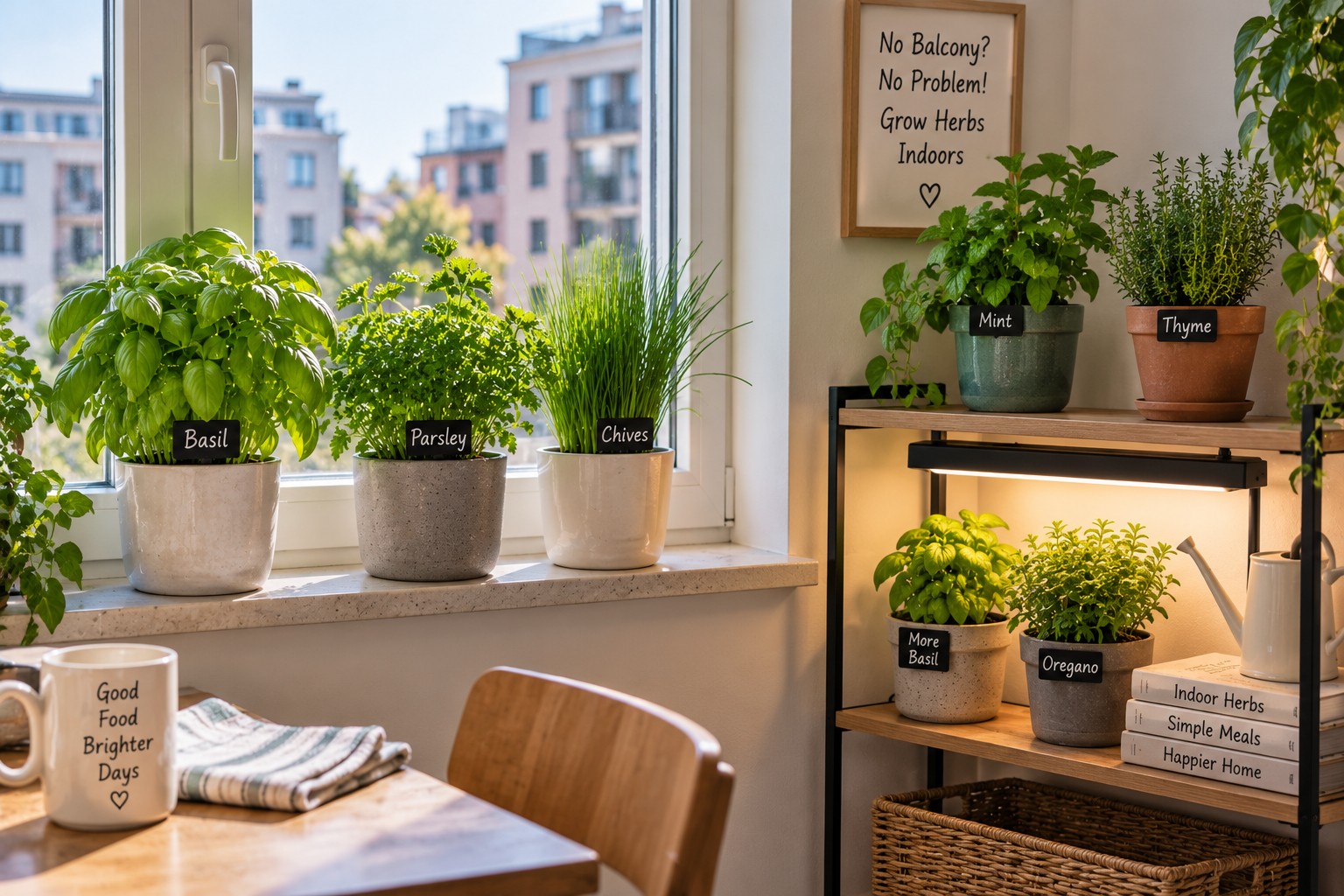
A balcony can certainly be useful.
It may provide strong natural light and extra space, and it keeps pots, spilled soil and watering outside your living area.
But a balcony isn't a requirement for growing culinary herbs.
In fact, an indoor setup has some advantages.
Your herbs are close to the kitchen, easy to observe and protected from many outdoor weather extremes.
You don't have to carry pots indoors because of an unexpected cold night or watch a summer storm flatten a small basil plant.
The challenge simply changes.
Indoors, light and usable growing space become especially important.
Solve those two questions first and the rest of the setup becomes much easier.
Start With the Best Light You Have
Before buying pots, shelves or equipment, walk around your home during daylight.
Look at your windows.
Which area receives the strongest useful natural light?
Don't judge only by how bright the room feels to you. A room can appear pleasantly bright while a plant several meters away from the window receives much less useful light.
Pay attention to:
- which direction the windows face
- how long direct sunlight reaches them
- nearby buildings that block light
- trees or overhangs outside
- seasonal changes
- how far a potential growing spot is from the glass
You don't need to calculate the perfect location before owning your first plant.
You do need to identify your best realistic options.
Option 1: Use a Windowsill
The simplest no-balcony herb garden may be sitting directly in front of you.
A suitable windowsill gives plants access to natural light without requiring additional furniture.
It's also wonderfully convenient.
You can see the herbs every day, notice when something changes and harvest a few leaves without walking farther than the window.
Before filling the sill with pots, check that it is:
- wide enough for stable containers
- bright enough for the herbs you want
- reasonably accessible for watering
- protected from severe drafts or temperature extremes
- somewhere pots won't constantly be knocked over
Don't turn every available centimeter into growing space.
Plants still need enough room to grow and for you to reach them.
Option 2: Put a Herb Shelf Near a Window
If your windowsill is too narrow, a small shelf, table or plant stand near a bright window can create more usable space.
This can work particularly well when you want several herbs but don't want every container lined up on the sill itself.
There is one important catch.
Near a window isn't the same as at a window.
Light intensity can drop considerably as you move farther into the room.
So don't choose the location based entirely on where the shelf looks nicest.
Put the plants where they can actually use the available light.
A beautiful herb shelf in a dark corner is mostly a beautiful way to grow disappointing herbs.
Option 3: Create a Grow-Light Herb Station
What if your best available window still doesn't provide enough light?
Then artificial lighting can change the possibilities dramatically.
A compact grow light can allow you to create a herb-growing area on a shelf, counter or small table that would otherwise be too dark.
That doesn't mean you need to transform your apartment into a commercial greenhouse.
For a small collection, the setup can remain simple:
- a shelf or stable surface
- a few herb pots
- a suitable grow light
- a practical way to position the light above the plants
- a timer if useful
Artificial lighting costs money and electricity, so use it because it solves a real limitation—not because every indoor garden supposedly needs one.
Don't Put Herbs Too Far From the Window
This mistake is easy to make.
You find a convenient empty shelf on the other side of a bright room and think, “There's plenty of light in here.”
To human eyes, perhaps.
To a sun-loving herb, the difference between being close to the window and several meters away can be enormous.
If you're relying on natural light, prioritize plant needs over interior-design symmetry.
Move the growing area closer to the useful light rather than expecting daylight to behave the same everywhere in the room.
If that isn't practical, supplemental lighting may be a better solution.
Choose Herbs for the Conditions You Have
It's easier to choose plants that suit your apartment than to spend months trying to persuade unsuitable plants that your apartment should suit them.
If you have strong natural light, you'll have more options.
If your available light is more limited, herb choice becomes particularly important.
That doesn't mean every plant sold as “easy” will thrive in every indoor location.
Consider light, available space and how much of the herb you actually use.
There is little value in filling a small apartment with six plants you rarely cook with.
Start with a few herbs that make sense for both your conditions and your kitchen.
Keep the Setup Small
Without a balcony, every pot competes with the rest of your living space.
That's actually a useful limitation.
Start with two or three herbs rather than trying to create an indoor farm on your first weekend.
A small setup is easier to:
- fit near your best light
- water without making a mess
- inspect for problems
- rotate or move when necessary
- understand as a beginner
Once those plants are doing well, you can decide whether your apartment has room for more.
Use Pots With Drainage
Growing completely indoors doesn't change the importance of drainage.
Use containers that allow excess water to escape.
Decorative pots without drainage can still be useful as outer containers, provided the herb itself remains in a draining inner pot and you manage excess water appropriately.
Don't sacrifice healthy root conditions because a particular container matches your furniture.
Your herb won't appreciate the color coordination.
Protect Your Indoor Surfaces
On a balcony, a little spilled water may not matter much.
On a wooden windowsill, desk or cabinet, it certainly can.
Put saucers or suitable waterproof trays beneath your pots.
Check them after watering and don't allow substantial amounts of drained water to sit there indefinitely.
Also consider what happens when you repot.
A washable tray, old newspaper or another protective surface can save you from discovering just how far a small amount of potting mix can travel across an apartment.
Indoor gardening should add herbs to your home, not a permanent layer of soil to your furniture.
Think About Heat, Cold and Airflow
Your brightest indoor location isn't automatically your best location.
A windowsill may also expose herbs to cold glass, winter drafts or strong temperature changes.
Elsewhere in the room, radiators, heaters and air-conditioning vents can create their own problems.
Look at the whole environment.
Aim for a location that combines useful light with reasonably stable conditions.
You don't need to create a perfectly controlled climate.
Just avoid obvious extremes when you have a better option.
Make Watering Easy
Your setup should make routine care convenient.
If reaching a plant requires moving six books, a lamp and half the contents of a kitchen counter, checking its soil will quickly become annoying.
Keep enough space around the pots to water them and inspect the soil.
Use containers that you can safely lift or move when necessary.
Keep a watering jug or can somewhere convenient.
And remember that indoor herbs don't all need water on the same schedule.
Check the soil rather than turning Saturday morning into compulsory watering day.
What If You Have Very Little Natural Light?
A dark apartment makes indoor herb gardening more challenging, but it doesn't necessarily make it impossible.
First, make sure you're genuinely using the best natural light available.
Then consider whether you can choose herbs that tolerate your conditions better.
If natural light remains inadequate, a grow light becomes the most direct way to solve the problem.
This is one area where spending money can make more sense than buying extra pots, plant gadgets or decorative accessories.
Light is a basic plant requirement.
A decorative label isn't.
A Simple No-Balcony Herb Garden Setup
If you want the simplest possible plan, start here.
Step 1: Find your best light.
Identify the brightest practical growing location in your home.
Step 2: Choose two or three herbs.
Pick herbs suited to your conditions and that you actually use.
Step 3: Use draining containers.
Keep plants in pots with drainage holes.
Step 4: Protect the surface underneath.
Add saucers or a waterproof tray.
Step 5: Keep the plants accessible.
Make watering, inspection and harvesting easy.
Step 6: Observe the plants.
Learn how quickly the pots dry and how the herbs respond to the available light.
Step 7: Add artificial light only if necessary.
If natural light is the limiting factor, solve that problem before buying decorative extras.
That's a functioning no-balcony herb garden.
It doesn't require outdoor space.
It doesn't require a dedicated gardening room.
And it certainly doesn't require twenty plants.
Your Indoor Space Is Enough
It's easy to look at photographs of enormous balconies, raised beds and outdoor herb gardens and assume you're missing something.
You're not.
A few healthy herbs growing beside a bright apartment window are still a herb garden.
So is a small shelf beneath a grow light.
Start with the space you have instead of waiting for the space you wish you had.
Learn where the light falls, choose a few suitable herbs and make the setup easy to care for.
If it produces fresh herbs you can walk over and harvest for dinner, it's doing its job.
For a broader guide to growing in an apartment:
Related: Apartment Herb Garden for Beginners →
To keep your setup inexpensive:
Related: Budget Indoor Herb Garden List →
For help during your plants' first days:
Related: First Week Herb Care Checklist →
And for the complete beginner path:
Back to: Getting Started With Indoor Herb Gardening →